There hasn’t been much time for reading in my crowded travel itinerary. I’ve been reading Gabriel Garcia Marquez’ autobiography, ‘Living to Tell the Tale’, a page at a time before the book slips from my exhausted hands and falls on my face. It’s a dense read, but worth persevering with because it’s a fascinating account of how he became a writer, wrestling with poverty and complicated Columbian politics.
Marquez is one of the greatest writers of the twentieth century and the way the book is written certainly helps to support the legend. He’s very frank about the subjective nature of autobiography: "Life is not what one lived, but what one remembers and how one remembers it in order to recount it." He is the narrator and creator of his own life-story, which is as dense and complex as any of his novels.
The book is crowded with unfamiliar names and a huge extended fammily whose relationships I didn’t completely grasp. I understood the way of living better when I went to Cuba where a whole family will live in a house with a communal eating, sitting, living area in the middle and a kitchen and courtyard at the back. Lots of rooms open off the communal living area and each section of the family has its own room - grandparents, in-laws, uncles, aunts, children. Marquez describes it beautifully and much of the book is about finding the space to write. The autobiography is a fantastic background for the fiction, which by his own admission, was firmly rooted in his own family history.
I also finished the Steig Larsson trilogy and really enjoyed it, though I know that some people have found it hard going. But I love thrillers with complicated plots and I felt the central characters were well developed and credible. If Larsson hadn’t died so suddenly I’d have been queueing up for the next instalment, which I think would have involved Salander’s search for her sister - a plot development signalled up in the last chapters. I want to know where her sister is and what happened to her. And I’m not putting money on Blomqvist’s new relationship either! I bet there’s someone out there already working on the sequel.
William Fiennes has somehow escaped me until now - maybe because autobiography isn’t one of my favourite genres, except when it’s a person I’m really interested in. But I saw the Snow Geese reviewed on another book blog (Dovegreyreader, who raved about it) and then found the Music Room in a remaindered book shop for £2.99.
I read it quickly - it’s refreshingly short - and with more pleasure than almost anything else I’ve read in a long time. The prose is beautiful and the way he takes readers into the world of the child is perfectly done. I can’t believe it’s only his second book.
William Fiennes was brought up in a moated castle (Broughton in Oxfordshire) though it’s never named in the book. Apparently he wanted every reader to imagine their own perfect castle as they read (interview here). But although his childhood was more privileged than most, he was lonely, being about 10 years younger than his nearest siblings. The castle became his playground, the film set for his imagination.
The family’s outwardly idyllic existence was overshadowed by tragedy. An older brother, Thomas, had been killed aged 3 in a freak accident before William was born. His eldest brother, Richard, suffered severe epilepsy that left him brain-damaged and sometimes violent. One of the most poignant moments in the book is the one where William comes round the corner of a secluded part of the garden -
“I saw Dad standing next to the house, his right arm stretched out, palm pressed flat against a buttress, his head dropped. He didn’t move.
‘What are you doing?’ I asked.
He said he was asking the house for some of its strength.”
The book also explores the murky history of epilepsy and the effect that it has had on families and communities over the centuries, being associated either with witchcraft or divine revelation. I couldn’t help thinking about the ‘lost prince’, George V’s son John, who was hidden away from the public gaze until he died at the age of 13. William Fiennes’ brother survives into adult-hood, but the effect on the family is profound. One reviewer called the book 'jaw-droppingly beautiful' and it is.
I love Henning Mankell’s Wallander books - well plotted and written - so I thought I’d try one of his mainstream novels, the newly published ‘Italian Shoes’. In the beginning I was gripped by it. Mankell gets right inside the psychology of an aging recluse who has lived alone on a remote Swedish island for twelve years with only a dog and cat for company and the occasional appearance of a hypochondriac postman called Jansson. The descriptions of the frozen landscape made me (almost) want to move to Scandinavia.
One morning, the solitary recluse wakes up to see an elderly woman standing on the ice beside the landing stage, propped up by her zimmer frame, and realises that his past has tracked him down. Hannah, who is dying prematurely of cancer, has come to find him and, in a variety of devious ways, bring him to account. After this point the book begins to fall apart.
I didn’t find the central section of the book credible and the writing was thinner than the first. The book picks up towards the end, but I always felt that my credibility was being stretched too far. What kept me reading was the character - an utterly believable, deeply flawed individual who is made to behave in ways that are alien to him. His redemption didn’t ring true, as if the author had striven for ways to bend character and plot towards the happy resolution he wanted the book to have.
The Italian shoes of the title? These have a mythic, almost fairy tale significance in the story. Deep in the forest dwells an elderly Italian shoe-maker who only makes shoes for international celebrities. A pair of red stilletto heels tap, in a rebellious fashion, through the plot, and a special pair of shoes is ordered for the hero of the novel, to be delivered at a symbolic moment.
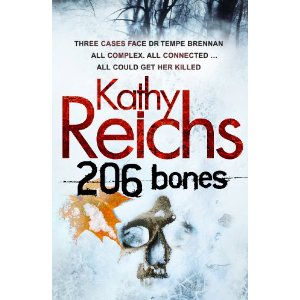
Kathy Reichs: 206 Bones, Steig Larsson: The Girl with the Dragon Tattoo, Shamini Flint: Inspector Singh Investigates: A Most Peculiar Malaysian Mystery
With all the travelling I’ve been doing lately by train and plane, there’s been plenty of time for the kind of light reading I enjoy. I love any kind of puzzle, but the plot convolutions of crime fiction are my all time favourites. I was attracted to Kathy Reichs when she began to publish because I was fascinated by the unpleasant details of forensic science. Who, in their right mind, would fancy picking someone’s toe nails out of the bathroom carpet, analysing maggots, or trawling the suspect’s sewage system for traces of blood? The feisty Tempe Brennan, apparently. But as the books have gone on being written, they have become more and more the same. Although the names may change the plot always follows the same pattern. I read 206 Bonesbecause I wanted to find out who did it (although I had guessed before the half way mark), but the book itself bored me and I probably won’t bother to pick up any more.
Steig Larsson’s trilogy has had a lot of press coverage and much hype, so I picked up the first book with some reservations. They didn’t last beyond the first two pages. The Girl with the Dragon Tattoo is as good as and probably better than its reputation. I was enthralled by the characterisation, the complexity of the plot and the originality of the story. Above all it is the depth of psychology that puts this book in the Premier League of crime fiction authors. I can’t wait to read the rest now!
I’m always on the look-out for new crime fiction authors and, having recently been to Singapore and about to return, I picked up one of the Inspector Singhnovels as the result of an Amazon ‘like-for-like’ recommendation. But they didn’t get my tastes quite right. Shamini Flint writes very well, with good characters and an original and beautiful setting, but I found the book a bit cosy. If you like Alexander McCall Smith’s detective fiction then you’ll probably like this.
This is one of the best books I’ve read in a long time - sheer pleasure from beginning to end. The Still Pointis a really exceptional first novel and deserved its Orange Prize long-listing. I’m not a great fan of the omniscient narrator, but in this book it works. We hover over the books’ characters like god in a helicopter eavesdropping on first one and then another across space and time - from an old house ‘freighted with memories’ in England, to the frozen deserts of the arctic. The author uses the narrative device to pull us in. ‘You can draw a little nearer, if you’re very quiet. Put your face close to his, close enough to feel the gentle rumble and stink of his breath; feel the damp warmth of hers on your own cheek. They fall asleep, as many couples do, first twined and then detached; as we rejoin them they have long since undergone this last conscious act, this delicate separation on the very brink of dreaming.’ Four young people; two marriages - one torn apart by arctic ice before it has properly begun, one in danger of foundering on the sunken reefs of past events. For Emily and Edward the other woman is the North Pole; for Julia and Simon it is the house, with its stuffed polar bear in the attic, the boxes of journals and diaries that Julia spends her days and nights among, the specimens of flora and fauna pinned, cased and hung on the wall. Simon has begun to feel that he is one of them. But in the space of a single day, everything is going to change. I hope Amy Sackville’spublishers, Portobello, are holding on to her very tightly because I think she’s going to be sensational.
It’s been a significant week for political dates. This weekend was the anniversary of the end of World War II in Europe and the subject of much celebration. But not in the middle east, which was subsequently carved up by the victorious allied forces and land apportioned in ways that have led to most of the conflicts of our recent history - most fundamental of all the partitioning of Palestine without any safeguards for the Palestinian people, twenty per cent of whom are Christian. May 6th wasn’t just the election, it was the last night of the Palestine Festival of Literature - an amazing event that celebrates the poetry and prose of the middle east, as well as including a number of British and American authors. The line up included Ahdaf Soueif (brilliant short stories as well as the Map of Love), Henning Mankell, Michael Palin, Carmen Callil, Deborah Moggach and Claire Messud. Palestine has, over the years, produced some brilliant writers and poets including Kalil Gibran. Right at the top would have to be Mahmoud Darwishwho died in 2008 and was regarded as the poet laureate and international voice of the Palestinian people - ‘a poet sharing the fate of his people, living in a town under siege, while providing them with a language for their anguish and dreams’. But he always declined to be involved with any form of extremism, deploring the excesses of Hamas. Mahmoud was born in Galilee in either 1941 or 42. Six years later the Israeli army occupied the area, bulldozing over four hundred Palestinian villages with their tanks. Mahmoud’s family were among those who fled over the border into Lebanon to escape the massacres that followed. When they returned, a year later, they discovered that because they had not been there to be ‘counted’ among the survivors, they were illegal immigrants into their own country and became what were described as ‘internal refugees’. Mahmoud Darwish began writing poetry while still at school, though he was banned from reciting it. Eventually, like so many, he left for a life of permanent exile, stateless and therefore without a passport. ‘All the birds followed My hand to the barriers of a distant airport. All the wheatfields All the prisons All the white graves All the borders All the waving handkerchiefs All the dark eyes All the eyes were with me But they crossed them out of the passport. Deprived of a name, of an identity, In a land I tended with both hands?’
But his poetry also celebrates the way that art can transcend oppression - the founding principle of the Palestine Festival of Literature. Mahmoud Darwish is always optimistic, always looking forward. ‘I have witnessed the massacre I am a victim of a map I am the son of plain words I have seen pebbles flying I have seen dew drops as bombs When they shut the gates of my heart on me Built barricades and imposed a curfew My heart turned into an alley My ribs into stones And carnations grew And carnations grew.
Darwish grew up reading the poetry of the Israeli poet Yehuda Amicai, and there is always an acknowledgement of the shared cultural and historical heritage of the Israeli and the Arab. They all came originally from Mesopotamia, and all acknowledge Abraham as their ancestor. The old testament is an account of shared history. In Darwish’s words: ‘We travel in the chariots of the Psalms, sleep in the tents of the prophets, and are born again in the language of nomads’ And he can ask, in the voice of the murdered Abel (a story which is also told in the Koran), ‘Brother... My brother! What did I do to make you destroy me?’
His latest collection is ‘Unfortunately it was Paradise’published by the University of California Press. It’s a joint translation by Munir Akash and Carolyn Forche and I don’t like it as much as the earlier translations by Abdullah al-Udhari. These new translations are less lyrical, less true to the spirit of the arabic originals. There are infelicities, such as ‘This is my language, this sound is the twinge of my blood.’ But the message always comes through.
In his journal of a visit to Ramallah ‘A River Dies of Thirst’ he writes: "Hope is not the opposite of despair, it is a talent." And in this poetry, written after he had experienced the first of the series of heart attacks that would eventually kill him, there is a fervent affirmation of the existence of hope. ‘What does life say to Mahmoud Darwish? You lived, fell in love, learned, and all those you will finally love are dead? In this hymn we lay a dream, we raise a victory sign, we hold a key to the last door, to lock ourselves in a dream. But we will survive because life is life.’
On the PalFest websitethere are a number of author’s blogs written by the visiting writers. Most were shocked by what they found and the way that they were treated as they tried to get into Palestine under the auspices of the British Council. Carmen Callil writes: Everywhere there are checkpoints and Israeli soldiers, many of them young women, young girls really, all of them draped in weapons, smoking in our faces as they grudgingly allow our bus of writers to proceed from A to B. ....Everywhere we see Jewish Settlements crowding out the old Palestinian towns. There are new settlements and the beginnings of hundreds more. Curfews, roads blocked, areas where only Israelis can go. Towns and villages closed off and hacked to pieces by road blocks, checkpoints and walls. Labels, tickets, permissions, queries, intermittent water, constant harassment and constant questioning’. Follow the link here for more and for a wonderful, moving video of the final event of the festival, where writers gave short readings.
I’m a great fan of a singer called Reem Kelani - British, but the child of Palestinian refugees. She is also a musicologist who has travelled the world collecting the traditional songs of the Palestinian diaspora. She performs often with Israeli musician Gilad Atzmon and his Orient House ensemble and she often sings settings of the poems of Mahmoud Darwish. There is quite a lot of her music on YouTube, but this is just an introduction.
It’s an irresistible title, and it’s a much better book than I expected. Paula Huntleywent to Kosovo with her husband when he was posted there after the Croatian war, as part of the rebuilding process. She lived among the Albanians of Prishtina, teaching English as a foreign language, and it exposed Paula to the harrowing life stories of her young students. Some of them had been in concentration camps, or hidden in bombed out buildings in order to survive the Serbian death squads, others had watched relatives executed or raped, most had eventually become refugees in neighbouring countries before returning to what was left of their homes. They are all desperate to learn English in order to better their lives and help to support their families. Among the squalor and the dereliction, the violent reprisals and the black-marketeering, Paula begins to run a book club, obtaining material from America, and their first book is Hemingway’s The Old Man and the Sea. At first she wonders if the book is too culturally alien to be understood, but the students identify with the old man’s struggle against adversity and the book club becomes a great success. Paula kept a journal of her daily life to send back to friends and family, and the journal eventually became the book. It’s interesting to watch Paula’s perspective changing with her experiences. The view of the world that she had learned in America becomes radically different. Soon she can write about ‘...the ignorance of Americans. We are, by the world’s standards, wealthy, and we have virtually unlimited access to news and books and magazines. We can travel, we can learn. But we are an island, cut off from the rest of the world not so much by geography as by complacency, by a lack of curiosity, by arrogance, perhaps. We are worldly, but we know little of the world.’ I’ve been reading quite a lot of Balkan history recently, because I’m thinking of using it for a narrative I’m working on. The story of what happened in the old territories of Yugoslavia is so appalling, it can hardly be credited in modern Europe, or that we allowed it to happen - not once, but again and again. It’s no coincidence that both the first and the second world wars were triggered by events in the Balkans. Its history is one of reprisal and counter-reprisal, conquest, colonisation and division. The nineteen forties was a particularly terrible period, yet, despite what was learned in Europe in 1945, our governments stood back and watched genocide, and we allowed them to. That is going to be a big blot on twentieth century history.