Showing posts with label Eco-literature. Show all posts

Sunday, 18 August 2013

Flight Behaviour by Barbara Kingsolver

Flight Behaviour

by Barbara Kingsolver

Fiction, Published by Faber and Faber.

 Whatever happened to Barbara Kingsolver? She is one of my all-time favourite authors - the Poisonwood Bible one of my all-time favourite books.  I read her last novel, The Lacuna, when it came out and was a little disappointed - though it still had some of the old magic on the page.  There were still beautiful passages to admire.

Flight Behaviour promised a return to form - an eco-novel with environmental issues integral to the plot.  But, oh dear, not very far into the novel, I became bored - really bored - and found it difficult to turn the pages.  Eventually, wading through virtual mud, I skipped to the end and found it as predictably dull as the rest of the book.  The only spark of magic was the moment when the heroine walks up into the woods for an illicit meeting with a lover and witnesses the leaves turning to flame.

It's sad to see one's favourite author losing the edge they had, particularly when their message has more relevance now than ever before.  And one does wonder how much authors' work is being influenced these days by what their publishers want from them, rather than allowing them to write what they want.  Please can I have Barbara Kingsolver back?

Tuesday, 6 August 2013

James Martin - The Change Agent, by Andrew Crofts

James Martin:  The Change Agent

by Andrew Crofts

Non-fiction/Biography

Very few people have made as much money predicting the future as James Martin.  First of all it was computers, then it was the future of the human race in the 21st century.  According to him, we are facing the biggest crisis in human history, but also our biggest opportunity.  We can turn the world into a utopia, or plunge into a terrifying ‘Dark Age’ taking the world’s fragile eco-system with us.

James Martin, who died very recently, was one of those who believed that the crises of population explosion, climate change and water shortage could be solved by technology.  But then, he was a computer buff who lived on an island in Bermuda with computer powered waterfalls, and a dazzling technology controlled house. He believed that eco-affluence was possible and that there is nothing morally wrong with it.  So long as we’re not screwing the planet to get rich, then it’s ok to have more of it than other people.  A few years ago he gave more than a hundred million pounds to fund a multi-disciplinary research institute at Oxford University into ways for the human race to survive the 21st century.

James Martin was currently predicting the ‘Singularity’ - a moment in history when computers will overtake the human mind in capability. We will be able to communicate with computers through thought alone and, as the computers will all be connected to each other in a gigantic international web, we will all be connected to each other, and the way we live our lives will be irrevocably changed.

The economic and climatic catastrophe that is looming on the horizon can be avoided by education of the masses, computer technology, clean energy, birth control and stem cell medicine.  What’s needed is education of the young in order to convince them that it’s all possible and that the future is in their hands.  Particularly women.  When you read James Martin’s work (latest The Meaning of the 21st Century), it all sounds very attractive.

He was an optimist, not a doom merchant - he held out hope.  But I was not convinced.  He may have been one of the greatest brains of the 20th century, but I think he was politically naive.  To implement his proposals there would have to be a political cataclysm so extreme it would confound history.  Human nature is conservative - we are not evolving as fast as our technologies and we are sadly lacking in that evolutionary skill ‘common sense’. Our old instincts have long since been bundled into a cupboard and the key turned in the door. The human animal is living on a fragile construction of falsehoods, and since technology has been our nemesis, I’m not sure we can be relied on to make it our salvation.

And how are we ever going to get the leaders of diverse political systems in Asia, America, Russia, Africa and Europe, to agree to put aside the politics of greed and power?  Looking back through history it seems that only a catastrophe would get them round a table to begin to talk. And once the catastrophe has happened, it might just be too late.

Andrew Crofts went out to Bermuda to stay with James Martin and interview him for this fascinating account of his life and beliefs.  It’s a very well-written book, but I would have liked a more rigorous questioning and discussion of the issues raised, though if I'd been a privileged guest on James Martin's Caribbean island, I probably wouldn't have felt able to ask the questions either!

Monday, 29 July 2013

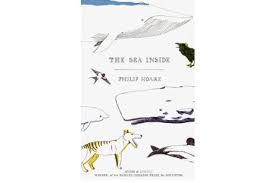
The Sea Inside: Philip Hoare

The Sea Inside

Philip Hoare

Published by Fourth Estate

We are 50% water - ‘we all contain the sea inside us’ - and evolution shows that life on earth originally crawled out of the sea.  But there is a theory that human beings may have emerged out of the ocean more recently than other life-forms. We still have vestigial webbed feet and fingers, almost the same ratio of fat to body mass as a dolphin, a natural instinct to hold our breath under water, and other adaptations that suggest a close connection with the mammals who live in the watery elements.  Was our ancestor a ‘watery ape’?

Our relationship with the sea fascinates Philip Hoare, who swims in it every day, often before dawn, and in every type of weather.  ‘The Sea Inside’ is a series of meditations on its mythologies, its biological and chemical complexity, its influence on our climate, and the importance of the oceanic eco-systems to our own survival. ‘The sea defines us,’ he writes, ‘connects us, separates us.  Most of us experience only its edges, our available wilderness on a crowded island’. 

Philip Hoare lives in these edgelands, on the fringes of the city of Southampton. ‘I didn’t choose to;  it chose me.  I might have found a more picturesque place, wild and romantic or urban and exciting; the kind of places people pass through here to reach.  A port city relies on its relationship to elsewhere.  Perhaps that’s why I like it so well, since it does not impose any identity on me’.  Living there, he is more aware than most of the dangerous foundations we have built our civilisation on. When he cycles to the shore every morning, he passes a forest of industrial installations; ‘tapering spires for a new place of worship; circular tanks as giant igloos... silos like newly-landed space ships ...  There’s no human scale to this petropolis ... it is brutal, practical, inevitable.’ 

In the book the author travels the world to swim with whales, explore remote shores, and record the sad history of human depredation.  We are not being kind to the ocean, but we need to change our ways, because our own salvation is carried in its deepest currents. 


A beautifully written book, as you'd expect from the author of Leviathon, who also lectures in creative non-fiction.  It's not quite in the same league as his last, but a moving, thoughtful read.


The Sea Inside
by Philip Hoare

PS - I was horrified to find that I had to pay much, much more for the Kindle edition than the paperback - it is extortion on the part of the publisher!

Saturday, 1 June 2013

The Long Delirious Burning Blue by Sharon Blackie

The Long Delirious Burning Blue
by Sharon Blackie
Published by Two Ravens Press

This is one of the most satisfying novels I've read in a long time - it really had me gripped and when I got to the end, I cried.  Not many books nowadays reduce me to tears, particularly ones that have happy endings.

The main character, Cat, is a 39 year old legal executive with an American pharmaceutical firm based in Arizona.  She's in a long term relationship with a nice guy, earns lots of money, has a beautiful home and is deeply unhappy.  Cat has begun to have crippling panic attacks which, at first, she believes to be the symptoms of physical illness and it is only when faced with a doctor's diagnosis that she realises they have their roots in anxieties that go back to childhood.

Everyone believes Cat to be completely in control and indestructible.  But it's only a mask to hide her vulnerability. Not even her partner knows how fragile she is.  Cat is afraid of flying, and when she has a massive panic attack on a business trip and is almost unable to get on the plane, she makes up her mind to deal with her fear the only way she knows how; by confronting it.  Cat decides to learn to fly and the terror and exhilaration she experiences become the key to understanding herself.

  'I have been asleep for forty years. This is what I need: this fear, this risk, this wind rocking my wings. This is what I have been missing. This is what it means to be alive – up here, on the edge of death.’ 

This is a novel about how fear can cripple our lives and prevent us living fully.  It's a novel about mothers and daughters - Cat's mother is an alcoholic and their relationship has been poisoned by guilt and blame and anger. But it's also a novel about the power of stories.  Our lives are a narrative and we can choose how to tell it - not only that, if we don't like the story we can change it.  As Cat does when she walks out of her career and her relationship into 'the long, delirious, burning blue'.

Cat's mother, Laura, is a story-teller, an author of children's books.  When the novel opens she has been sober for years, but has lost the ability to write.  Returning to the west-highland village where she had lived with her violent husband, she begins to work through her own story and, in writing it down, begins to heal herself and her relationship with her daughter.

One of my favourite bits from the book is the 'mission statement' Cat has to approve in a board meeting, which is the subject of her first rebellion against corporate America.  She can no longer swallow the meaningless jargon and the half-truths.  My other favourites were the flying scenes - so vivid I was up there in the cockpit almost sick with vertigo.  And I really fancied the flying instructor . . .

The author, Sharon Blackie, is the editor of Two Ravens Press, based on the island of Lewis in the Outer Hebrides. Two Ravens publish poetry and fiction and the beautiful glossy magazine 'Earthlines'.  Their remit is broadly 'ecoliterature' but they state that they are looking for 'writing that is capable of challenging and unpicking the status quo, of shifting the worldview of their readers away from the creed of "Progress is Growth is Consumption".'  This novel certainly does that.  It's Sharon's first novel - and the only parallel I can think of is Barbara Kingsolver, who manages to combine ecological and political issues with beautiful prose. I'm now eagerly awaiting Sharon's second novel, The Bee Dancer, which is apparently coming soon.


The title is a quote from a poem called 'High Flight' written by 19 year old Canadian poet John Gillespie Magee, a spitfire pilot killed in a mid-air collision in 1941.